Makes › Ferrari › 166 › 166 Inter · Rare production · 1948–1950 Ultra Rare
Ferrari
166 Inter
Ferrari 166 Inter, the first road-going 12-cylinder Ferrari GT, built in a very small series.
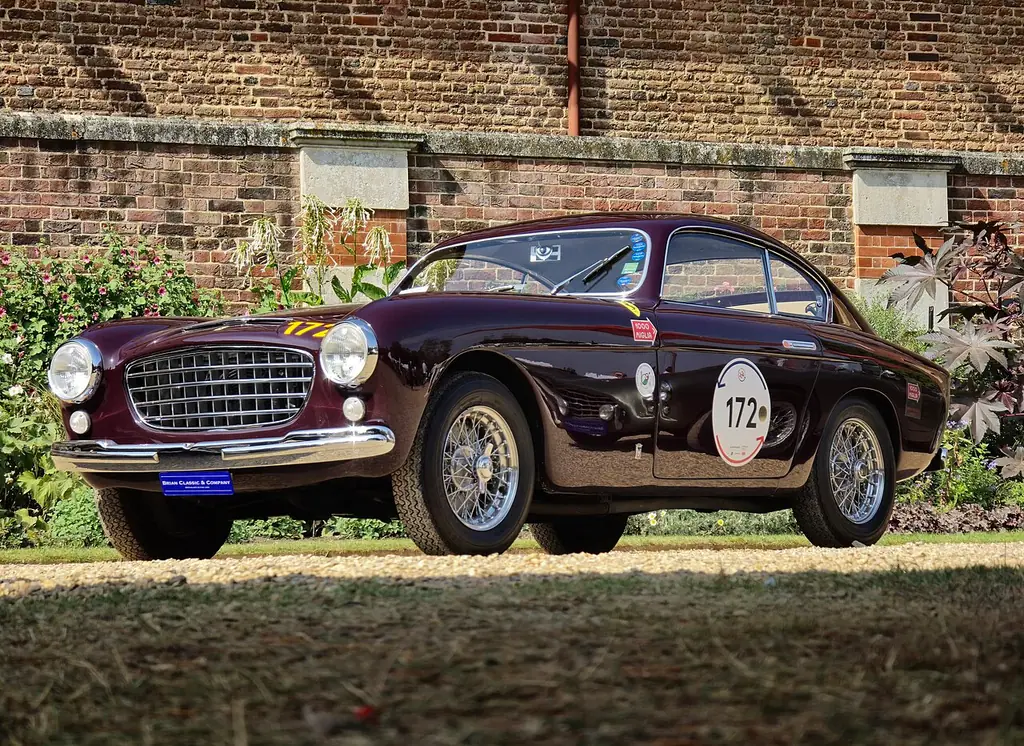
Photo: Calreyn88 · CC BY-SA 4.0

Contents
01Overview
At a glance
- Built
- 38 Built
- Years
- 1948–1950
- Engine
- Front longitudinal 60-degree V12, light alloy block and head · 1,995 cc / 2.0 LFactory: 1,995 cc
- Power
- 82 kW / 112 PSFactory: 110 hp · converted
- Top speed
- 170 km/hFactory: 170 km/h
- Body
- Not yet verified
- Designer
- Not yet verified
- In this archive
- Not yet verified
- Surviving
- Not yet verified
Sources and any conflicting figures are in the sections below.
Why it matters
The 166 Inter was the road-going version of the 2-litre Ferrari sports racers. It was one of the first Ferraris to do well outside Italy and helped build the marque's reputation in the American market. Because each body was hand-built by an outside coachbuilder, nearly every car differs in detail.
How rare is it?
Six separate kinds of rarity – never combined into one number.
Each kind of rarity is rated separately and never combined.
02Production & history
Production
Every figure says what it counts.
| What is counted | Figure | Basis | Status |
|---|---|---|---|
| Total model productioncars listed in the barchetta.cc register by coachwork (14 Touring coupe, 7 Touring berlinetta, 6 Vignale coupe, 1 Vignale berlinetta, 1 Ghia, 4 Stabilimenti Farina berlinetta, 3 cabriolet, 1 coupe, 1 Bertone cabriolet) | 381 | Factory production | Registry reported |
Independent counts (e.g. engine and colour) are never combined into a calculated figure. Surviving examples are never presented as original production.
History
The 166 Inter was built between 1948 and 1950 on a 2,420 mm tubular steel chassis, carrying the odd chassis numbers used for Ferrari's road cars. Most were coupes. Carrozzeria Touring built the largest number, followed by Vignale and Stabilimenti Farina, with single cars by Ghia and Bertone.
The mechanical layout followed the 166 competition cars: a 2-litre V12, a five-speed gearbox and a rigid rear axle, but with twin-distributor ignition and a single twin-choke carburettor as standard. A triple twin-choke set-up could be ordered for extra performance. Although they were road cars, many owners also used them in competition.
Variants
How each version differs from the standard 166 Inter.
No variants documented yet. Have a source? Contribute it.
03Specifications
Technical specifications
Engine
| Engine family | Not yet verified |
|---|---|
| Engine code | Not yet verified |
| Layout | Front longitudinal 60-degree V12, light alloy block and head1 Registry reported |
| Displacement | 1,995 cc / 2.0 LFactory: 1,995 cc1 Registry reported |
| Bore | 60 mmFactory: 60 mm1 Registry reported |
| Stroke | 58.8 mmFactory: 58.8 mm1 Registry reported |
| Compression ratio | 7.5:11 Registry reported |
| Valvetrain | Single overhead camshaft per bank, two valves per cylinder2 |
| Fuel system | One twin-choke carburettor as standard; triple twin-choke set-up optional2 |
| Power | 82 kW / 112 PSFactory: 110 hp · converted1 Registry reportedSource states bhp. |
| Power at | 6,000 rpm1 Registry reported |
| Torque | Not yet verified |
Transmission & drivetrain
| Gearbox | Not yet verified |
|---|---|
| Gears | 51 Registry reported |
| Driven wheels | Rear2 |
Chassis, body & dimensions
| Chassis | Elliptical-section steel tubes1 Registry reported |
|---|---|
| Front suspension | Independent, unequal-length wishbones, transverse leaf spring, hydraulic shock absorbers2 |
| Rear suspension | Live axle, semi-elliptic leaf springs, hydraulic shock absorbers, anti-roll bar2 |
| Brakes | Not yet verified |
| Steering | Not yet verified |
| Body construction | Not yet verified |
| Wheelbase | 2,420 mmFactory: 2,420 mm1 Registry reported |
| Length | Not yet verified |
| Width | Not yet verified |
| Height | Not yet verified |
| Front track | 1,250 mmFactory: 1,250 mm1 Registry reported |
| Rear track | 1,200 mmFactory: 1,200 mm1 Registry reported |
| Kerb weight | 800 kgFactory: 800 kg1 Registry reported |
| Dry weight | Not yet verified |
Performance
| Maximum speed | 170 km/hFactory: 170 km/h1 Registry reported |
|---|---|
| 0–100 km/h | Not yet verified |
| Fuel tank | 80 LFactory: 80 L1 Registry reported |
“Not yet verified” means no source has been checked for that value yet. Nothing is estimated to fill a gap.
04Colours & options
Factory colours & interiors
Original paint and trim, with the number of cars in each where a source gives it.
Not yet documented. Have a source? Contribute it.
Factory options & codes
Codes are shown exactly as written by the manufacturer.
Not yet documented. Have a source? Contribute it.
05Individual cars
Chassis register
Every documented car, with its colours, history and where it is now. Open a row for the full record. Known chassis are not automatically authenticated originals.
Not yet documented. Have a source? Contribute it.
Competition history
Every race result of the individual cars, in date order. Click a chassis number to open its full record in the register.
Not yet documented. Have a source? Contribute it.
Auction & sale history
Documented public sales of the individual cars. Click a chassis number to open its full record in the register.
Not yet documented. Have a source? Contribute it.
See one in person
Museums where an example of this car can be seen.
No example is documented on public display yet. Have a source? Contribute it.
06Reference
Identification guide
How to tell an original from a replica or later conversion.
The register lists 38 cars with odd, S-suffixed chassis numbers from 005S to 0079S. Bodies by Touring (coupe and berlinetta), Vignale, Stabilimenti Farina (coupe, berlinetta and cabriolet), Ghia and Bertone are recorded. The Inter was the only Ferrari road model of its period offered with disc road wheels as an alternative to wire wheels; both types used splined hubs. Bumpers were standard: light rubber-faced blades on Touring cars and heavy chromed bumpers on the Ghia, Farina and Finale-bodied cars.
Sources
Each number links to the exact facts it supports.
-
1
166 Inter - Register Level B barchetta.cc
- Total 38
- Front longitudinal 60° V12, light alloy cylinder block and head
- 166.25 / 1,995 cc
- Bore and stroke 60 x 58.8 mm
- Compression ratio 7.5:1
- 110 bhp at 6,000 rpm; 55 bhp/litre
- 110 bhp at 6,000 rpm
- 5-speed gearbox + reverse
- Chassis Elliptical-section steel tubes
- Wheelbase, front and rear track 2,420/1,250/1,200 mm
- 2,420/1,250/1,200 mm
- Kerb weight 800 kg
- Top speed 170 km/h
- Fuel tank 80 litres
-
2
Ferrari 166 Inter (past models) Level A Ferrari S.p.A.
- single overhead camshaft per bank, two valves per cylinder
- fitted with a single twin choke carburettor as standard
- 5-speed gearbox driving through a rigid rear axle
- independent, unequal-length wishbones, transverse leaf spring
- live axle, semi-elliptic springs, hydraulic shock absorbers, anti-roll bar
Keep exploring
More from Ferrari
-
Ferrari · 1954
375 MM Spider by Pinin Farina ("Ingrid Bergman" car, 0456AM)
1 Built
-
Ferrari · 1970
512 S Modulo (Pininfarina)
1 Built
-
Ferrari · 1980
Pinin
1 Built
-
Ferrari
246 SP
2 Built
More from Italy
-
Lancia · 1931–1943
Artena
Production not yet verified
-
Iso · 1972
Varedo
1 Built
-
Pagani
Zonda C12 S 7.3 Roadster
Production not yet verified
-
Lamborghini
Diablo GTR (1999-2000)
32 Built
62 other makes from ItalyAbarthACM AutomobiliAlfa RomeoAres DesignATSAuto Avio CostruzioniAutobianchiAznomB EngineeringBandiniBertoneBizzarriniBrixia-ZüstCagivaCarrozzeria Touring SuperleggeraCeiranoChiribiriCisitaliaCizetaColoniCoviniDallaraDe TomasoDiattoF.I.A.L. LegnanoFervesFiatFissoreFlorentiaGhiaInnocentiIntermeccanicaIsoIsotta FraschiniItalaItaldesignLaffiteLamborghiniLanciaMaseratiAll makes →