Contents
01Overview
At a glance
- Built
- 2,487 Built
- Years
- 1969–1974
- Engine
- 65° V6, transverse, rear-mounted · 2,419.2 cc / 2.4 LFactory: 2,419.2 cc
- Power
- 143 kW / 194 PSFactory: 143 kW
- Top speed
- 235 km/hFactory: 235 km/h
- Body
- Not yet verified
- Designer
- Pininfarina (body design carried over from the 206 GT)
- In this archive
- Not yet verified
- Surviving
- Not yet verified
Sources and any conflicting figures are in the sections below.
Why it matters
The 246 GT was the V6 road car that followed the 206 GT as Enzo Ferrari agreed to hand the production-car side of the business to Fiat. Ferrari describes it as commercially very successful.
How rare is it?
Six separate kinds of rarity – never combined into one number.
Each kind of rarity is rated separately and never combined.
02Production & history
Production
Every figure says what it counts.
| What is counted | Figure | Basis | Status |
|---|---|---|---|
| Total model productionDino 246 GT and GTS built 1969-1974, including 1,274 GTS (the lead figure of 3,569 is not supported) | 2,4871 | Factory production | Independently researched |
Independent counts (e.g. engine and colour) are never combined into a calculated figure. Surviving examples are never presented as original production.
History
The 246 GT replaced the 206 GT and made its official debut at the Turin Show in November 1969, although production had already begun. The 2-litre V6 gave way to a 2.4-litre engine, and the wheelbase went from 2280 mm to 2340 mm.
The 246 GTS, with a black removable roof panel, was introduced in the spring of 1972 at the Geneva Show. The road cars had no real competition career; a 246 GT entered by North American Racing Team ran at Le Mans in 1972.
Variants
How each version differs from the standard Dino 246 GT/GTS.
No variants documented yet. Have a source? Contribute it.
03Specifications
Technical specifications
Engine
| Engine family | Not yet verified |
|---|---|
| Engine code | Not yet verified |
| Layout | 65° V6, transverse, rear-mounted2 |
| Displacement | 2,419.2 cc / 2.4 LFactory: 2,419.2 cc2 |
| Bore | 92.5 mmFactory: 92.5 mm2 |
| Stroke | 60 mmFactory: 60 mm2 |
| Compression ratio | 9:12 |
| Valvetrain | twin overhead camshafts per bank, two valves per cylinder2 |
| Fuel system | three Weber 40 DCN F/7 twin-choke carburettors (L and M series); 40 DCN F/13 on E series2 |
| Power | 143 kW / 194 PSFactory: 143 kW2Ferrari also gives 195 hp, described as claimed. Kept as stated. |
| Power at | 7,600 rpm2 |
| Torque | Not yet verified |
Transmission & drivetrain
| Gearbox | all-synchromesh manual2 |
|---|---|
| Gears | 52 |
| Driven wheels | Not yet verified |
Chassis, body & dimensions
| Chassis | tubular steel frame2 |
|---|---|
| Front suspension | independent, unequal-length wishbones, coil springs, telescopic dampers, anti-roll bar2 |
| Rear suspension | independent, unequal-length wishbones, coil springs, telescopic dampers, anti-roll bar2 |
| Brakes | servo-assisted ventilated discs (Girling on L series, ATE later)2 |
| Steering | rack-and-pinion2 |
| Body construction | Not yet verified |
| Wheelbase | 2,340 mmFactory: 2,340 mm2 |
| Length | 4,235 mmFactory: 4,235 mm2 |
| Width | 1,700 mmFactory: 1,700 mm2 |
| Height | 1,135 mmFactory: 1,135 mm2 |
| Front track | 1,425 mmFactory: 1,425 mm2 |
| Rear track | 1,430 mmFactory: 1,430 mm2Figure as listed. Ferrari says Series M added 30 mm to the rear track, so later cars are wider at the rear. |
| Kerb weight | Not yet verified |
| Dry weight | 1,080 kgFactory: 1,080 kg2 |
Performance
| Maximum speed | 235 km/hFactory: 235 km/h2 |
|---|---|
| 0–100 km/h | Not yet verified |
| Fuel tank | 65 LFactory: 65 L2 |
“Not yet verified” means no source has been checked for that value yet. Nothing is estimated to fill a gap.
04Colours & options
Factory colours & interiors
Original paint and trim, with the number of cars in each where a source gives it.
Not yet documented. Have a source? Contribute it.
Factory options & codes
Codes are shown exactly as written by the manufacturer.
Not yet documented. Have a source? Contribute it.
05Individual cars
Chassis register
Every documented car, with its colours, history and where it is now. Open a row for the full record. Known chassis are not automatically authenticated originals.
Not yet documented. Have a source? Contribute it.
Competition history
Every race result of the individual cars, in date order. Click a chassis number to open its full record in the register.
Not yet documented. Have a source? Contribute it.
Auction & sale history
Documented public sales of the individual cars. Click a chassis number to open its full record in the register.
Not yet documented. Have a source? Contribute it.
See one in person
Museums where an example of this car can be seen.
No example is documented on public display yet. Have a source? Contribute it.
06Reference
Identification guide
How to tell an original from a replica or later conversion.
Series L cars (late 1969 to 1970) have a single knock-off spinner on the road wheels and a body in steel with an aluminium front lid. Series M (early 1971) has five-bolt wheels and a rear track 30 mm wider. Series E (1971 to 1974) carries the M changes plus further engine and gearbox changes. The GTS has the removable roof and no rear quarter windows.
Sources
Each number links to the exact facts it supports.
-
1
Ferrari Dino 246 GT (1969) - Ferrari.com Level A
- 2487 Dino 246 GT and GTS built 1969-1974, including 1,274 GTS (the lead figure of 3,569 is not supported)
-
2
Ferrari Dino 246 GT (1969) - history, design, engine, technical details Level C Ferrari S.p.A.
- Type rear, transverse, 65° V6
- Total displacement 2419.20 cc
- Bore/stroke 92.5 x 60 mm
- Compression ratio 9 : 1
- twin overhead camshafts per bank, two valves per cylinder
- three Weber 40 DCN F/7
- Maximum power 143 kW (195 hp) at 7600 rpm
- all-synchromesh five-speed transmission
- Transmission 5-speed + reverse
- Frame tubular steel
- Front suspension independent, unequal-length wishbones
- Rear suspension independent, unequal-length wishbones
- Servo-assisted ventilated disc brakes, initially Girling
- Steering rack-and-pinion
- Wheelbase 2340 mm
- Length 4235 mm
- Width 1700 mm
- Height 1135 mm
- Front track 1425 mm
- Rear track 1430 mm
- Weight 1080 kg (dry)
- Top speed 235 km/h
- Fuel tank capacity 65 litres
Keep exploring
More from Ferrari
-
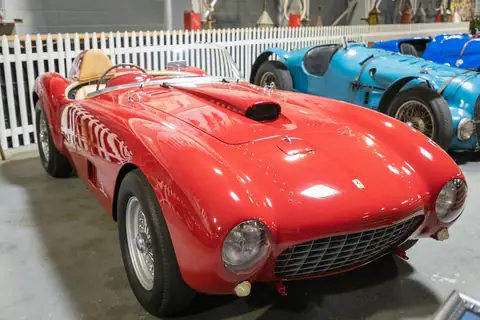
Ferrari · 1954
375 MM Spider by Pinin Farina ("Ingrid Bergman" car, 0456AM)
1 Built
-
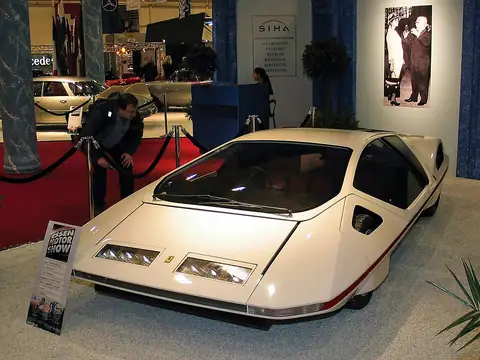
Ferrari · 1970
512 S Modulo (Pininfarina)
1 Built
-
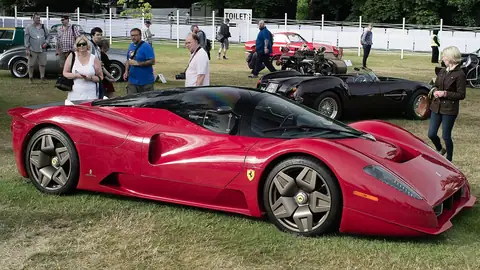
Ferrari · 2005–2006
P4/5 by Pininfarina (2006)
1 Built
-
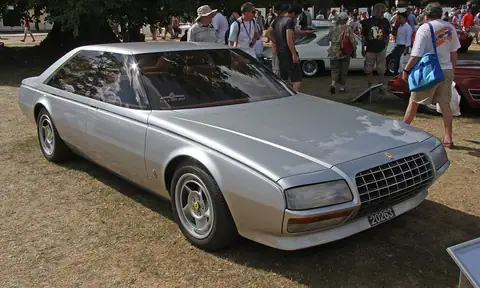
Ferrari · 1980
Pinin
1 Built
More from Italy
-
Maserati
Biturbo 420 (1981-1983)
Production not yet verified
-
Lamborghini · 1966–1968
400 GT (incl. 2+2)
250 Built
-
Abarth
595 50th Anniversary
Production not yet verified
-
Lancia · 1972–1975
Stratos HF Stradale
Production not yet verified
62 other makes from ItalyAbarthACM AutomobiliAlfa RomeoAres DesignATSAuto Avio CostruzioniAutobianchiAznomB EngineeringBandiniBertoneBizzarriniBrixia-ZüstCagivaCarrozzeria Touring SuperleggeraCeiranoChiribiriCisitaliaCizetaColoniCoviniDallaraDe TomasoDiattoF.I.A.L. LegnanoFervesFiatFissoreFlorentiaGhiaInnocentiIntermeccanicaIsoIsotta FraschiniItalaItaldesignLaffiteLamborghiniLanciaMaseratiAll makes →