Makes › Sunbeam › 350hp (Blue Bird) · Historically significant · 1920
Sunbeam
350hp (Blue Bird)
V12 aero-engined LSR car; Campbell first over 150 mph (1925)
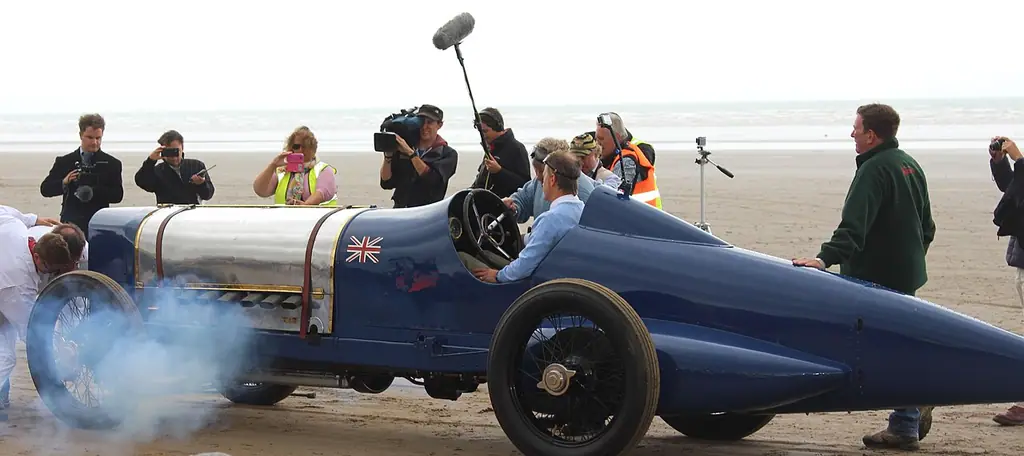
Photo: Thruxton · CC BY-SA 4.0

Contents
01Overview
At a glance
- Built
- 1 Built
- Years
- 1920
- Engine
- V12, modified 'Manitou' aero engine · 18,000 cc / 18 LFactory: 18 L
- Power
- Not yet verified
- Top speed
- 245.9 km/hFactory: 152.8 mph · converted
- Body
- Not yet verified
- Designer
- Louis Coatalen
- In this archive
- Not yet verified
- Surviving
- 1 (independently researched)
Sources and any conflicting figures are in the sections below.
Why it matters
The 350hp held the world land speed record on three occasions. Driven by Kenelm Lee Guinness, it set its first record at Brooklands in 1922, and as Malcolm Campbell's Blue Bird it became the first car to exceed 150 mph in 1925.
How rare is it?
Six separate kinds of rarity – never combined into one number.
Each kind of rarity is rated separately and never combined.
02Production & history
Production
Every figure says what it counts.
| What is counted | Figure | Basis | Status |
|---|---|---|---|
| Total model productionthe 350 HP Sunbeam car, preserved at the National Motor Museum, Beaulieu | 12 | Surviving examples | Independently researched |
| Total model productionindividual car: the Sunbeam 350hp Land Speed Record car in the National Motor Museum collection (identity confirmed) | 11 | Factory production | Independently researched |
Independent counts (e.g. engine and colour) are never combined into a calculated figure. Surviving examples are never presented as original production.
History
Sunbeam chief engineer Louis Coatalen designed the car and it was built at the Wolverhampton works during 1919 and early 1920. Harry Hawker, Rene Thomas, Jean Chassagne and Kenelm Lee Guinness raced it with varying success; Guinness took the record at 133.75 mph at Brooklands on 17 May 1922. Malcolm Campbell bought the car in 1923, rebuilt it and repainted it in blue as Blue Bird. He set records of 146.16 mph at Pendine Sands in September 1924 and 150.76 mph on 21 July 1925.
Variants
How each version differs from the standard 350hp (Blue Bird).
No variants documented yet. Have a source? Contribute it.
03Specifications
Technical specifications
Engine
| Engine manufacturer | Sunbeam (Manitou aero engine)3 Independently researched |
|---|---|
| Engine family | Not yet verified |
| Engine code | Not yet verified |
| Layout | V12, modified 'Manitou' aero engine4 |
| Cylinders | 123 Independently researched |
| Displacement | 18,000 cc / 18 LFactory: 18 L4 |
| Bore | 120 mmFactory: 120 mm5 Independently researchedFrom an enthusiast source (level D) – not yet confirmed by the maker or a registry. |
| Stroke | Not yet verified |
| Compression ratio | Not yet verified |
| Valvetrain | Twin overhead camshafts, four valves per cylinder2 Independently researchedMuseum page (C) describes the Manitou engine fitted to this car. The car record (S1, D) gives 2 exhaust and 1 inlet valve with a single overhead camshaft. The stronger source is used; the conflict is unresolved. |
| Fuel system | 2 Claudel-Hobson HC7 carburettors5 Independently researchedFrom an enthusiast source (level D). |
| Power | Not yet verified |
| Power at | 2,000 rpm2 Independently researchedEngine rating speed as given by the museum page. |
| Torque | Not yet verified |
Transmission & drivetrain
| Gearbox | Four-speed gearbox and drive shaft4 |
|---|---|
| Gears | 44 |
| Final drive | Bevel back axle, 1.5 to 15 Independently researchedFrom an enthusiast source (level D). |
| Driven wheels | Not yet verified |
Chassis, body & dimensions
| Chassis | Channel section frame5 Independently researchedFrom an enthusiast source (level D). |
|---|---|
| Front suspension | Elliptic springs (one entry for the car)5 Independently researchedSource gives a single entry for the suspension, so it also applies to the rear. |
| Rear suspension | Not yet verified |
| Brakes | Drum brakes on the rear wheels only3 Independently researched |
| Steering | Not yet verified |
| Body construction | Not yet verified |
| Wheelbase | Not yet verified |
| Length | Not yet verified |
| Width | Not yet verified |
| Height | Not yet verified |
| Front track | Not yet verified |
| Rear track | Not yet verified |
| Kerb weight | 1,550 kgFactory: 1,550 kg5 Independently researchedSource gives only 'Weight'; kerb or dry basis not stated. |
| Dry weight | Not yet verified |
Performance
| Maximum speed | 245.9 km/hFactory: 152.8 mph · converted4Campbell's quoted fastest speed in 1925; the record average was 150.76 mph. |
|---|---|
| 0–100 km/h | Not yet verified |
| Fuel tank | Not yet verified |
“Not yet verified” means no source has been checked for that value yet. Nothing is estimated to fill a gap.
04Colours & options
Factory colours & interiors
Original paint and trim, with the number of cars in each where a source gives it.
Not yet documented. Have a source? Contribute it.
Factory options & codes
Codes are shown exactly as written by the manufacturer.
Not yet documented. Have a source? Contribute it.
05Individual cars
Chassis register
Every documented car, with its colours, history and where it is now. Open a row for the full record. Known chassis are not automatically authenticated originals.
Not yet documented. Have a source? Contribute it.
Competition history
Every race result of the individual cars, in date order. Click a chassis number to open its full record in the register.
Not yet documented. Have a source? Contribute it.
Auction & sale history
Documented public sales of the individual cars. Click a chassis number to open its full record in the register.
Not yet documented. Have a source? Contribute it.
See one in person
Museums where an example of this car can be seen.
No example is documented on public display yet. Have a source? Contribute it.
06Reference
Identification guide
How to tell an original from a replica or later conversion.
The car is built around a V12 Manitou aircraft engine of 18,322 cc, with drum brakes on the rear wheels only. In 1923-24 Malcolm Campbell added a streamlined nose cowl and a pointed tail, so photographs from before and after those changes show a different shape.
Sources
Each number links to the exact facts it supports.
-
1
National Motor Museum – Sunbeam 350hp Level B
- 1 individual car: the Sunbeam 350hp Land Speed Record car in the National Motor Museum collection (identity confirmed)
-
2
Sunbeam engines: The Manitou Level C University of Wolverhampton local history museum
- The car is preserved in the National Motor Museum at Beaulieu in Hampshire.
- twin overhead camshafts, operating four valves per cylinder
- The engine developed 300h.p. at 2,000r.p.m.
-
3
The Racing Campbells: The Cars (350 HP Sunbeam 1922) Level D racingcampbells.com · 2011-07-15
- Manitou aircraft engine
- V-12, 18,322-cc Manitou aircraft engine
- drum brakes on the rear only
-
4
Sunbeam 350hp Level A National Motor Museum, Beaulieu
- modified 18 litre Sunbeam V12 'Manitou' aero engine
- Transmission was via a four-speed gearbox and drive shaft
- four-speed gearbox
- Its fastest speed was 152.8mph
-
5
The Racing Campbells - The Cars Level D racingcampbells.com (fan site)
- Bore 120mm
- Carburettor 2 Claudel-Hobson HC7
- Back axle bevel, 1.5 to 1
- Chassis: Channel section frame
- Suspension: elliptic springs
- Length 16ft, Weight 1,550kg
Keep exploring
More from Sunbeam
-
Sunbeam · 1927
1000hp ("The Slug")
1 Built
-
Sunbeam · 1925
Tiger (V12 record car)
1 Built
-
Sunbeam · 1962–1963
Harrington Alpine Series C
20 Built
-
Sunbeam · 1961
Harrington Alpine (Series A)
110 Built
More from United Kingdom
-
Lagonda · 1938–1940
V12
189 Built
-
Lotus · 1952–1955
Mark VI
110 Built
-
Alvis · 1935–1939
Firebird
450 Built
-
Tyrrell
002 (1971)
Production not yet verified
134 other makes from United KingdomACAiredaleAlan Mann RacingAllardAlvisArabArashArielArmstrong SiddeleyArrowsAscariAston MartinAtalantaAtlantisAustinAustin-HealeyBedfordBentleyBerkeleyBluebirdBMCBondBrabhamBristolBritish LeylandBroadspeedBrookeBrough SuperiorCampbell-RailtonCaparoCaterhamChevronConnaughtCooperCrayfordDaimlerDavid BrownDawsonDeLoreanDuttonAll makes →