Makes › Tatra › T77 / T77a · Rare production · 1934–1938 Very Rare
Tatra
T77 / T77a
First series-production aerodynamic car (Ledwinka/Jaray); about 255 in total
Still being researched: full specifications. Everything shown is checked against the cited sources. Know more? Send us a source.
Contents
01Overview
At a glance
- Built
- 255 Built
- Years
- 1934–1938
- Engine
- Rear-mounted air-cooled 90-degree V8 (behind rear axle) · 3,000 cc / 3 LFactory: 3 L
- Power
- 44.7 kW / 60.8 PSFactory: 60 hp · converted
- Top speed
- 140 km/hFactory: 140 km/h
- Body
- Not yet verified
- Designer
- Hans Ledwinka, Erich Ledwinka and Erich Übelacker (body after Paul Jaray)
- In this archive
- Not yet verified
- Surviving
- 20 (independently researched)
Sources and any conflicting figures are in the sections below.
Why it matters
The T77 is generally regarded as the first aerodynamic car built in series for the road. Its public demonstrations pushed other manufacturers to accelerate their own streamlined designs, and its rear-engined backbone layout set the pattern Tatra followed for decades.
How rare is it?
Six separate kinds of rarity – never combined into one number.
Each kind of rarity is rated separately and never combined.
02Production & history
Production
Every figure says what it counts.
| What is counted | Figure | Basis | Status |
|---|---|---|---|
| Total model productionAs few as twenty of 255 T77/T77A survive, per Revs Institute (approximate) | 202 | Surviving examples | Independently researched |
| Total model productionT77 and T77a built in period (about 100 + 154) | 2551 | Factory production | Independently researched |
Independent counts (e.g. engine and colour) are never combined into a calculated figure. Surviving examples are never presented as original production.
History
The T77 grew out of the V570 prototype and Hans Ledwinka's backbone chassis, developed by Ledwinka with his son Erich and Erich Übelacker, while the streamlined body drew on Paul Jaray's wind-tunnel work. It was presented at the 1934 Prague Auto Salon with an air-cooled V8 mounted behind the rear axle. About 100 T77s were built before the T77A arrived with a 3.4-litre engine, a longer wheelbase and a three-headlamp nose; a further 154 T77As followed between 1936 and 1938. In all only 255 cars were made, and as few as twenty are thought to survive.
Variants
How each version differs from the standard T77 / T77a.
No variants documented yet. Have a source? Contribute it.
03Specifications
Technical specifications
Engine
| Engine family | Not yet verified |
|---|---|
| Engine code | Not yet verified |
| Layout | Rear-mounted air-cooled 90-degree V8 (behind rear axle)2 Independently researched |
| Displacement | 3,000 cc / 3 LFactory: 3 L3 Independently researchedT77 3.0-litre air-cooled V8; the T77A has a 3.4-litre engine. |
| Bore | Not yet verified |
| Stroke | Not yet verified |
| Compression ratio | Not yet verified |
| Valvetrain | Overhead valves, hemispherical combustion chambers2 Independently researched |
| Fuel system | Not yet verified |
| Power | 44.7 kW / 60.8 PSFactory: 60 hp · converted2 Independently researched |
| Power at | 3,500 rpm2 Independently researched |
| Torque | Not yet verified |
Transmission & drivetrain
| Gearbox | Four-speed manual in unit with engine and rear axle2 Independently researched |
|---|---|
| Gears | 42 Independently researched |
| Driven wheels | Not yet verified |
Chassis, body & dimensions
| Chassis | Backbone chassis2 Independently researched |
|---|---|
| Front suspension | Not yet verified |
| Rear suspension | Not yet verified |
| Brakes | Hydraulic drum brakes all round2 Independently researched |
| Steering | Not yet verified |
| Body construction | Not yet verified |
| Wheelbase | Not yet verified |
| Length | Not yet verified |
| Width | Not yet verified |
| Height | Not yet verified |
| Front track | Not yet verified |
| Rear track | Not yet verified |
| Kerb weight | Not yet verified |
| Dry weight | 1,700 kgFactory: 1,700 kg3 Independently researchedStated for the T77; magnesium alloy used for engine, gearbox, suspension and body. |
Performance
| Maximum speed | 140 km/hFactory: 140 km/h2 |
|---|---|
| 0–100 km/h | Not yet verified |
| Fuel tank | Not yet verified |
“Not yet verified” means no source has been checked for that value yet. Nothing is estimated to fill a gap.
04Colours & options
Factory colours & interiors
Original paint and trim, with the number of cars in each where a source gives it.
Not yet documented. Have a source? Contribute it.
Factory options & codes
Codes are shown exactly as written by the manufacturer.
Not yet documented. Have a source? Contribute it.
05Individual cars
Chassis register
Every documented car, with its colours, history and where it is now. Open a row for the full record. Known chassis are not automatically authenticated originals.
Not yet documented. Have a source? Contribute it.
Competition history
Every race result of the individual cars, in date order. Click a chassis number to open its full record in the register.
Not yet documented. Have a source? Contribute it.
Auction & sale history
Documented public sales of the individual cars. Click a chassis number to open its full record in the register.
Not yet documented. Have a source? Contribute it.
See one in person
Museums where an example of this car can be seen.
No example is documented on public display yet. Have a source? Contribute it.
06Reference
Identification guide
How to tell an original from a replica or later conversion.
Genuine cars have the rear-mounted air-cooled V8, so there is no front radiator opening, plus a dorsal fin on the engine cover flanked by cooling slats, no running boards and rear wings integrated into the body. Early T77s have a split flat-panel windscreen and near-flush headlamps in the round nose; later cars have a three-piece windscreen, and the T77A has three headlamps, two in the front wings and one in the centre. Headlamp placement varied from car to car.
Sources
Each number links to the exact facts it supports.
-
1
The Revs Institute – Tatra T77: the brilliant and influential Czech wonder Level B
- 255 T77 and T77a built in period (about 100 + 154)
-
2
Tatra T77 - The brilliant and influential Czech wonder Level B Wouter Melissen · Revs Institute (Automedia)
- as few as twenty of these pioneering machines have survived
- air-cooled 90-degree V8 mounted behind the rear axle
- overhead valves, hemispherical combustion chambers
- 60 hp at 3,500 rpm (T77)
- four-speed gearbox mounted in unit with engine and rear axle
- four-speed gearbox
- backbone chassis Ledwinka created in the early 1920s
- hydraulic drum brakes on all four corners
- could easily reach its claimed top speed of 140 km/h
-
3
1947 Tatra T87 Aerodynamic Saloon Level B conceptcarz.com
- T77 3.0-liter air-cooled V8; T77A 3.4-liter engine
- extensive magnesium alloy kept weight down to 1,700kg
Keep exploring
More from Tatra
-
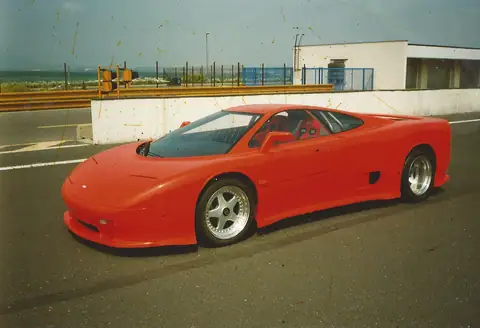
Tatra · 1991
MTX V8 (Metalex)
4 Built
-
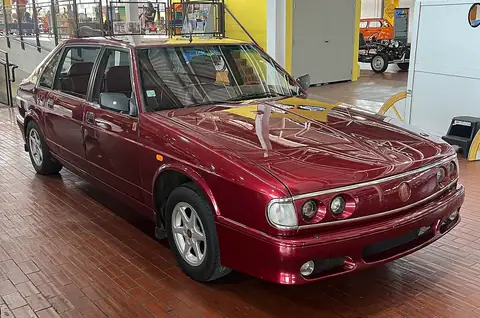
Tatra · 1996–1999
700
29 Built
-
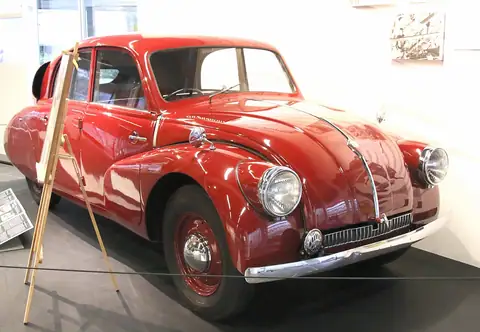
Tatra · 1936–1939
T97
508 Built
-
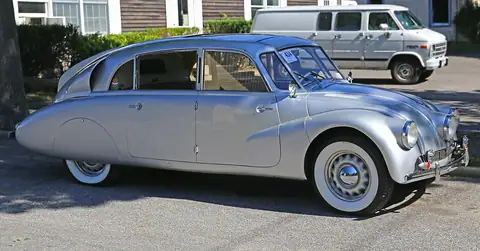
Tatra · 1936–1950
87
3,023 Built
More from Czech Republic
-
Škoda
860
Production not yet verified
-
Aero · 1933–1934
1000 (Aero 20)
236 Built
-
Laurin & Klement · 1905–1907
Voiturette A
44 Built
-
Jawa · 1937–1939
Minor (1934-1940)
Production not yet verified
6 other makes from Czech RepublicAeroJawaLaurin & KlementMTXŠkodaZbrojovka Brno