Contents
01Overview
At a glance
- Built
- Not yet verified
- Years
- Not yet verified
- Engine
- Rear-mounted horizontally opposed six (H-6) · 5,490 cc / 5.5 LFactory: 335 cu in · converted
- Power
- 124 kW / 168 PSFactory: 166 hp · converted
- Top speed
- 192 km/hFactory: 119 mph · converted
- Body
- Not yet verified
- Designer
- Alex Tremulis (member of Tucker's design team)
- In this archive
- Not yet verified
- Surviving
- 47 (registry reported)
Sources and any conflicting figures are in the sections below.
Why it matters
The Tucker 48 was the most ambitious post-war attempt by an independent to break into the American car market, offering a rear-engined layout and safety features such as a pop-out windscreen, padded dash and a steering 'Cyclops' headlamp. The company collapsed after only 51 cars, and the car's story has fascinated the public and collectors ever since.
How rare is it?
Six separate kinds of rarity – never combined into one number.
Each kind of rarity is rated separately and never combined.
Photos
Exterior, interior and detail photos with their licences.
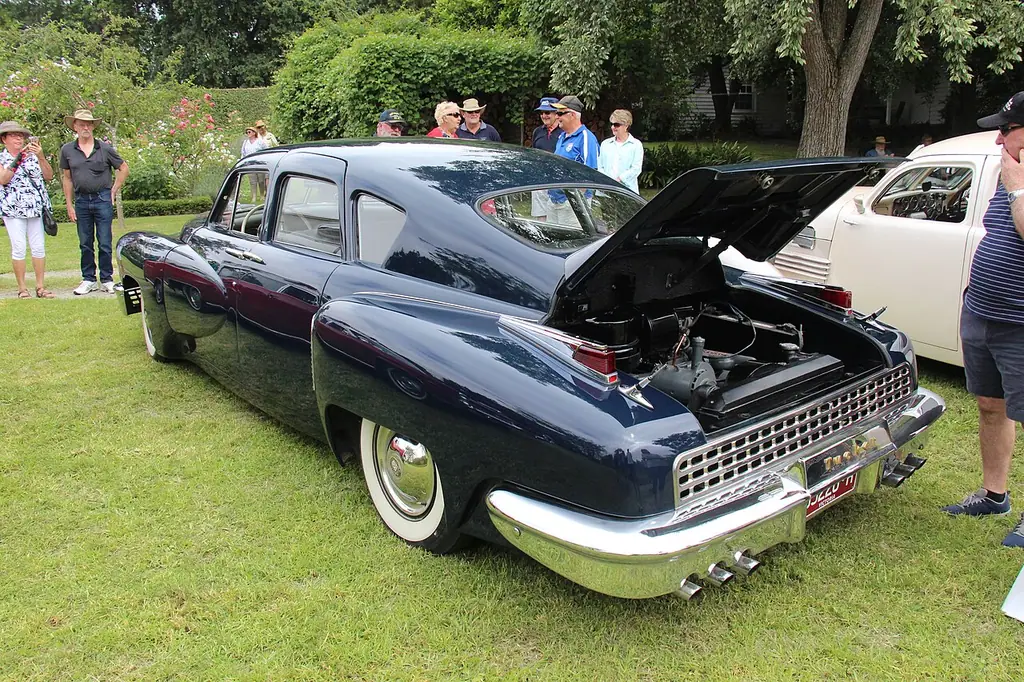
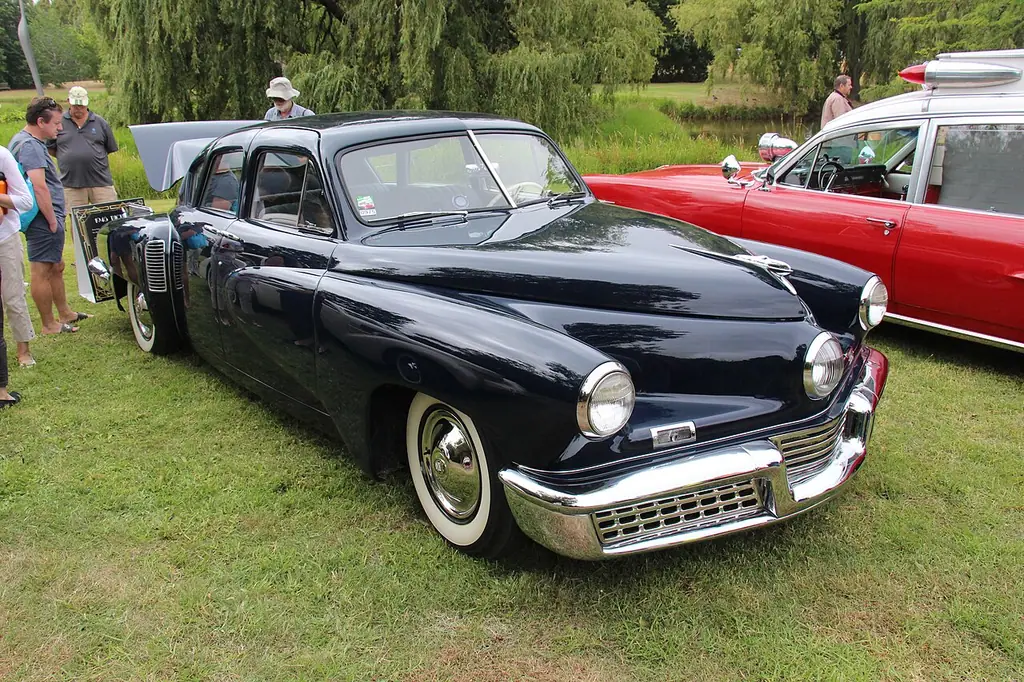
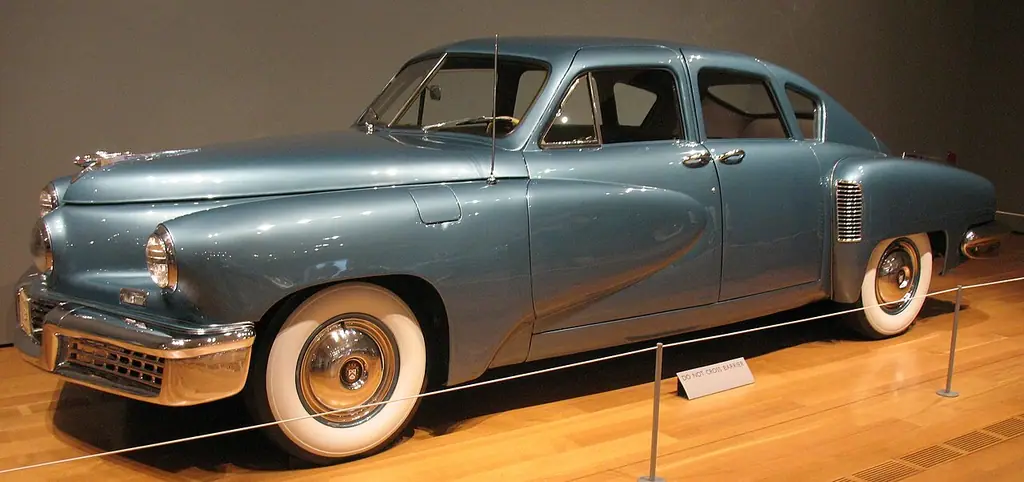
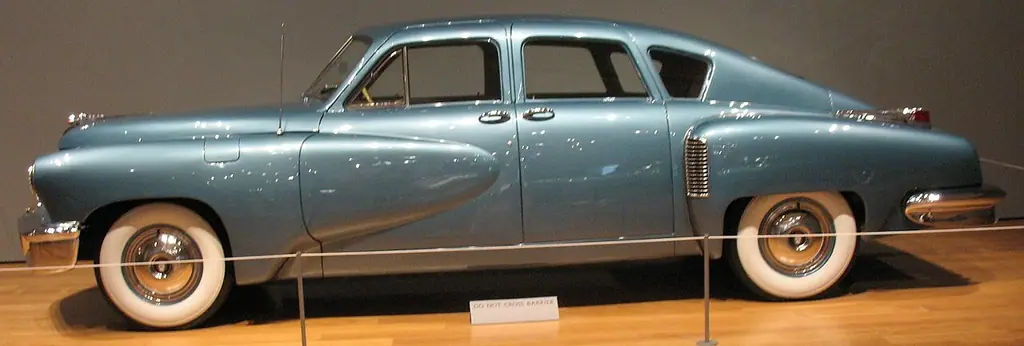
 Tucker 48 (Wikimedia Commons: Tucker 48)
Photo: Sicnag · CC BY 2.0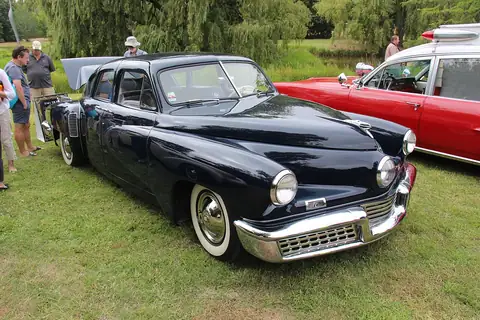 Tucker 48 (Wikimedia Commons: Tucker 48)
Photo: Sicnag · CC BY 2.0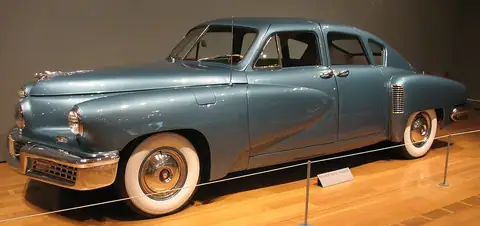 Tucker 48 (Wikimedia Commons: Tucker 48)
Photo: James Emery from Douglasville, United States · CC BY 2.0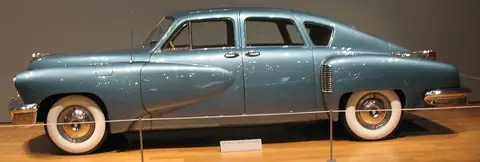 Tucker 48 (Wikimedia Commons: Tucker 48)
Photo: James Emery from Douglasville, United States · CC BY 2.0


02Production & history
Production
Every figure says what it counts.
| What is counted | Figure | Basis | Status |
|---|---|---|---|
| Total model production47 of 51 cars (prototype plus 50 pilot cars) survive, per Tucker Automobile Club president Jay Follis | 474 | Surviving examples | Registry reported |
| Total model productioncars built (1 prototype + 50 pilot production), per Tucker Corp. build records and the March 1949 court inventory; 47 survive | 511,2,3 | Surviving examples | Independently researched |
Independent counts (e.g. engine and colour) are never combined into a calculated figure. Surviving examples are never presented as original production.
History
Preston Tucker founded his company in the mid-1940s, when the established makers had no new post-war models, and sketches of the car appeared in Science Illustrated in December 1946. Built by hand in Chicago, production comprised the 'Tin Goose' prototype and 50 pilot-production cars. An SEC investigation for stock fraud in 1948 ended in full acquittal but drove investors away, and the company closed on March 3, 1949; the remaining cars were sold at a court-ordered auction in October 1950. Of the 51 cars, 47 survive.
Variants
How each version differs from the standard 48.
No variants documented yet. Have a source? Contribute it.
03Specifications
Technical specifications
Engine
| Engine manufacturer | Franklin Aircooled Motors (aluminium block)5 Independently researched |
|---|---|
| Engine family | Not yet verified |
| Engine code | Not yet verified |
| Layout | Rear-mounted horizontally opposed six (H-6)6,4 Independently researched |
| Cylinders | 65 Independently researched |
| Displacement | 5,490 cc / 5.5 LFactory: 335 cu in · converted6 Independently researched |
| Bore | 114 mmFactory: 4.5 in · converted5 Independently researched |
| Stroke | 88.9 mmFactory: 3.5 in · converted5 Independently researched |
| Compression ratio | 7:15 Independently researched |
| Valvetrain | OHV, hydraulic actuation5 Independently researched |
| Fuel system | 2-barrel Stromberg downdraft carburettor, mechanical fuel pump5 Independently researched |
| Power | 124 kW / 168 PSFactory: 166 hp · converted6 Independently researched |
| Power at | 3,200 rpm5 Independently researched |
| Torque | 610 NmFactory: 450 lb-ft · converted5 Independently researchedTucker club and Audrain give 372 lb-ft. |
| Torque at | 1,800 rpm5 Independently researched |
Transmission & drivetrain
| Gearbox | Tucker 'Y-1' four-speed pre-selector6 Independently researched |
|---|---|
| Gears | 45 Independently researched |
| Driven wheels | Not yet verified |
Chassis, body & dimensions
| Chassis | Not yet verified |
|---|---|
| Front suspension | Not yet verified |
| Rear suspension | Not yet verified |
| Brakes | 4-wheel hydraulic drums, 11 in diameter5 Independently researched |
| Steering | Not yet verified |
| Body construction | Not yet verified |
| Wheelbase | 3,300 mmFactory: 130 in · converted5 Independently researchedTucker club fact sheet gives 128 in. |
| Length | 5,560 mmFactory: 219 in · converted5 Independently researched |
| Width | 2,010 mmFactory: 79 in · converted5 Independently researched |
| Height | 1,520 mmFactory: 60 in · converted5 Independently researched |
| Front track | 1,630 mmFactory: 64 in · converted5 Independently researched |
| Rear track | 1,650 mmFactory: 65 in · converted5 Independently researched |
| Kerb weight | 1,921 kgFactory: 4,235 lb · converted5 Independently researchedTucker club gives 4,200 lb. |
| Dry weight | Not yet verified |
Performance
| Maximum speed | 192 km/hFactory: 119 mph · converted5 Independently researchedTucker club: estimated 120 mph. |
|---|---|
| 0–100 km/h | Not yet verified |
| 0–60 mph | 10 s5 Independently researched |
| Fuel tank | 75.7 LFactory: 20 gal-us · converted5 Independently researched |
“Not yet verified” means no source has been checked for that value yet. Nothing is estimated to fill a gap.
04Colours & options
Factory colours & interiors
Original paint and trim, with the number of cars in each where a source gives it.
Not yet documented. Have a source? Contribute it.
Factory options & codes
Codes are shown exactly as written by the manufacturer.
Not yet documented. Have a source? Contribute it.
05Individual cars
Chassis register
Every documented car, with its colours, history and where it is now. Open a row for the full record. Known chassis are not automatically authenticated originals.
Not yet documented. Have a source? Contribute it.
Competition history
Every race result of the individual cars, in date order. Click a chassis number to open its full record in the register.
Not yet documented. Have a source? Contribute it.
Auction & sale history
Documented public sales of the individual cars. Click a chassis number to open its full record in the register.
Not yet documented. Have a source? Contribute it.
See one in person
Museums where an example of this car can be seen.
No example is documented on public display yet. Have a source? Contribute it.
06Reference
Identification guide
How to tell an original from a replica or later conversion.
Production is documented by serial number: the prototype plus pilot cars numbered up to 1051, the latter the only car completed after the factory closed. Four cars no longer exist: No. 1018 (crashed and parted out), No. 1023 (burned in a 1978 warehouse fire and crushed), No. 1027 (rolled during Indianapolis endurance testing, parts reused on other Tuckers) and No. 1042 (sold without engine in 1950, fate unknown). A car claiming one of these numbers therefore needs scrutiny.
Sources
Each number links to the exact facts it supports.
-
1
History Level B The Official Tucker Club of America · 2011-06-08
- 51 were built, of which 47 survive now
-
2
Tucker History, fact sheet Level B Tucker Automobile Club of America (Wayback capture) · 2011-06-08
- 51 were built, of which 47 survive now
-
3
Old Cars Weekly – The Tucker Tally (Jay Follis, president, Tucker Automobile Club of America) Level B
- 51 cars built (1 prototype + 50 pilot production), per Tucker Corp. build records and the March 1949 court inventory; 47 survive
-
4
The Tucker Tally Level B Jay Follis · Old Cars Weekly · 2010-04-13
- 51 were built. 47 survive.
- rear-engined
-
5
1948 Tucker specifications Level C The Henry Ford (Wayback capture) · 2012-02-05
- Aluminum block produced by Franklin Aircooled Motors
- Horizontally opposed rear-mounted flat six cylinder engine
- Bore: 4.5 in.
- Stroke: 3.5 in.
- Compression ratio: 7:1
- Valves: OHV, hydraulic actuation
- 2-bbl. Stromberg downdraft carburetor
- 166 b.h.p. @ 3200 r.p.m.
- Maximum torque: 450 lbs/ft @ 1800 r.p.m.
- 450 lbs/ft @ 1800 r.p.m.
- 4-speed manual with Bendix vacuum-electrical preselector
- 4-wheel hydraulic drums, internal expanding ... Drum diameter 11 in.
- Wheelbase: 130 in.
- Length: 219 in.
- Width: 79 in.
- Height: 60 in.
- Front tread: 64 in.
- Rear tread: 65 in.
- Weight: 4235 lbs.
- Top speed 119 m.p.h. at Sebring, 1956
- 0-60 m.p.h. 10.0 sec. (Mechanix Illustrated, Aug. 1948)
- Fuel Tank: 20 gal.
-
6
1948 Tucker Model 48 Level C Audrain Automobile Museum
- H-6 (horizontally opposed)
- 335 cu. in. / 5.48 L
- 166 hp
- Tucker "Y-1" 4-speed pre-selector
Keep exploring
More from Tucker
This is the only Tucker documented so far.
More from United States
-
Shelby American · 1969
GT350 Convertible (1969)
194 Built
-
Studebaker · 1958
Golden Hawk (1958)
878 Built
-
Ford · 2012
Mustang Boss 302 Laguna Seca (2012)
767 Built
-
Kaiser
Manhattan (Argentina) (1955)
Production not yet verified
141 other makes from United StatesAC PropulsionAcuraAllstateAMCAmerican LaFranceAmerican MotorsAmerican UnderslungApteraArmstrongArnoltAuburnBaldwin-MotionBantamBarris KustomsBendixBerger ChevroletBill ThomasBollingerBremerBuckeyeBuffumBuickCadillacCallawayCastleCheckerChevroletChristieChryslerClenetCodaColumbiaConsulierCordCunninghamCzingerDana ChevroletDean JeffriesDeSotoDetroit ElectricAll makes →