Makes › Finnvan › Finnvan II · Prototype · 1988–1989 Ultra Rare
Finnvan
Finnvan II
Finnish electric delivery-van prototype with a glass-fibre body, built for trials with the Finnish Post by an Imatran Voima–Neste consortium; only three were built.
Still being researched: full specifications. Everything shown is checked against the cited sources. Know more? Send us a source.
Contents
01Overview
At a glance
- Built
- 3 Built
- Years
- 1988–1989
- Engine
- DC electric motor with thyristor controller; 60 V lead-acid batteries (90 Ah)
- Power
- 3 kW / 4.08 PSFactory: 3 kW
- Top speed
- 60 km/hFactory: 60 km/h
- Body
- Not yet verified
- Designer
- Not yet verified
- In this archive
- Not yet verified
- Surviving
- 1 (independently researched)
Sources and any conflicting figures are in the sections below.
Why it matters
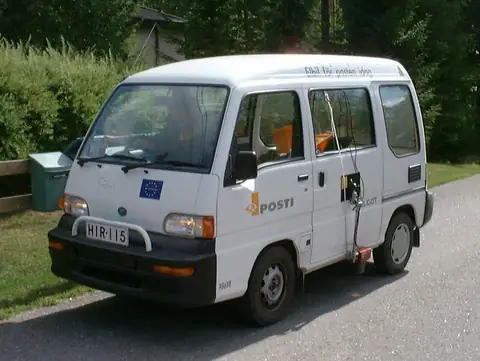
The Finnvan II was the prototype stage of Finland's electric-van programme of the 1980s and the direct technical predecessor of the Elcat Cityvan. Built for urban light deliveries and tested in real mail delivery, in 1989 one covered 197 km in a single run before the project moved on to the Subaru-based Elcat Cityvan.
How rare is it?
Six separate kinds of rarity – never combined into one number.
Each kind of rarity is rated separately and never combined.
02Production & history
Production
Every figure says what it counts.
| What is counted | Figure | Basis | Status |
|---|---|---|---|
| Total model productionOne example in the Postimuseo (Finnish Postal Museum) collection, object PM-ES-4187; the fate of the other two is not stated | 12 | Surviving examples | Independently researched |
| Total model productionFinnvan II prototypes built | 31 | Factory production | Independently researched |
Independent counts (e.g. engine and colour) are never combined into a calculated figure. Surviving examples are never presented as original production.
History
The van was a joint project of Imatran Voima and Neste with a third partner (Lokari according to the Postal Museum, Leo Laine Oy according to the Museum of Technology); Lokari Oy made the glass-fibre body. The prototype was shown to the media in Helsinki on 21 December 1988, and from February 1989 the Finnish Post and Telecommunications service tried it on delivery rounds, first in Helsinki and then in Espoo. On 26 September 1989 a Finnvan II, fitted with a 555 kg battery, covered 197 km at an average of 48 km/h.
Three were built and tested in year-round conditions. Development was dropped because the technology was not mature enough, the body was too expensive to make and did not withstand the twisting loads of use; commercial production was judged too costly, and the work continued in the Subaru-based Elcat Cityvan. One example survives in the Postal Museum collection.
Variants
How each version differs from the standard Finnvan II.
No variants documented yet. Have a source? Contribute it.
03Specifications
Technical specifications
Engine
| Engine family | Not yet verified |
|---|---|
| Engine code | Not yet verified |
| Layout | DC electric motor with thyristor controller; 60 V lead-acid batteries (90 Ah)2 Independently researched |
| Displacement | Not yet verified |
| Bore | Not yet verified |
| Stroke | Not yet verified |
| Compression ratio | Not yet verified |
| Fuel system | Not yet verified |
| Power | 3 kW / 4.08 PSFactory: 3 kW2 Independently researchedContinuous rating; peak 6 kW. |
| Power at | Not yet verified |
| Torque | Not yet verified |
Transmission & drivetrain
| Gearbox | Fixed reduction (no gearbox)2 Independently researched |
|---|---|
| Gears | Not yet verified |
| Driven wheels | Not yet verified |
Chassis, body & dimensions
| Chassis | Not yet verified |
|---|---|
| Front suspension | Not yet verified |
| Rear suspension | Not yet verified |
| Brakes | Hydraulic2 Independently researched |
| Steering | Not yet verified |
| Body construction | Glass-fibre body by Lokari Oy2 Independently researched |
| Wheelbase | Not yet verified |
| Length | Not yet verified |
| Width | Not yet verified |
| Height | Not yet verified |
| Front track | Not yet verified |
| Rear track | Not yet verified |
| Kerb weight | 550 kgFactory: 550 kg2 DisputedTekniikan museo gives 750 kg, of which 185 kg batteries. |
| Dry weight | Not yet verified |
Performance
| Maximum speed | 60 km/hFactory: 60 km/h2 DisputedTekniikan museo gives 58 km/h. Postimuseo: 0–50 km/h 13 s, range 50–60 km, 0.10 kWh/km, 1.5 m³ load space. |
|---|---|
| 0–100 km/h | Not yet verified |
| Fuel tank | Not yet verified |
“Not yet verified” means no source has been checked for that value yet. Nothing is estimated to fill a gap.
04Colours & options
Factory colours & interiors
Original paint and trim, with the number of cars in each where a source gives it.
Not yet documented. Have a source? Contribute it.
Factory options & codes
Codes are shown exactly as written by the manufacturer.
Not yet documented. Have a source? Contribute it.
05Individual cars
Chassis register
Every documented car, with its colours, history and where it is now. Open a row for the full record. Known chassis are not automatically authenticated originals.
Not yet documented. Have a source? Contribute it.
Competition history
Every race result of the individual cars, in date order. Click a chassis number to open its full record in the register.
Not yet documented. Have a source? Contribute it.
Auction & sale history
Documented public sales of the individual cars. Click a chassis number to open its full record in the register.
Not yet documented. Have a source? Contribute it.
See one in person
Museums where an example of this car can be seen.
No example is documented on public display yet. Have a source? Contribute it.
06Reference
Identification guide
How to tell an original from a replica or later conversion.
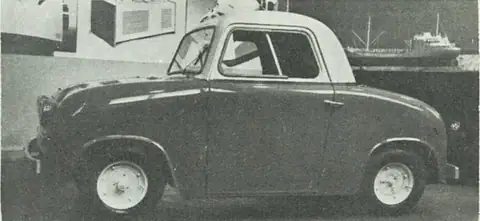
The Finnvan has a yellow-painted glass-fibre body with a sliding door at the front of each side and a tailgate that slides up over the roof. The driver sits on the right; the left side of the cab holds electrical equipment. Lockable hatches on both sides give access to the battery packs. It has a direct-drive transmission with no gearbox.
Sources
Each number links to the exact facts it supports.
-
1
From Automobiles to Autonomous Biomes – 2 (Tekniikan museo) Level C
- 3 Finnvan II prototypes built
-
2
pakettiauto; sähköauton prototyyppi Finnvan (object PM-ES-4187) Level C Postimuseo (Finnish Postal Museum), via Finna
- PM-ES-4187, POSTIMUSEON KOKOELMAT, Esinekokoelma
- Moottori DC ... tyristorisäädin, lyijyakut: jännite 60 V kapasiteetti 90 Ah/5 h
- teho 3 kw huippu 6 kw
- voimansiirto kiinteällä välityksellä
- hydrauliset jarrut
- lasikuitukori; Korin valmisti Lokari Oy
- paino: 550 kg
- huippunopeus 60 km/h
Keep exploring
More from Finnvan
This is the only Finnvan documented so far.