Makes › Daimler-Motoren-Gesellschaft › Mercedes › Mercedes 28/95 PS Sport short chassis (Coppa Florio) · Rare specification · 1921–1922
Daimler-Motoren-Gesellschaft
Mercedes 28/95 PS Sport short chassis (Coppa Florio)
Short-chassis competition 28/95; Max Sailer won the Coppa Florio and was 2nd in the Targa Florio
Still being researched: full specifications. Everything shown is checked against the cited sources. Know more? Send us a source.
Contents
01Overview
At a glance
- Built
- Not yet verified
- Years
- 1921–1922
- Engine
- Inline six-cylinder, long-stroke, overhead camshaft with V-position valves · 7,280 cc / 7.3 LFactory: 7,280 cc
- Power
- 82 kW / 112 PSFactory: 110 hp · converted
- Top speed
- Not yet verified
- Body
- Not yet verified
- Designer
- Max Sailer and Paul Daimler (conversion)
- In this archive
- Not yet verified
- Surviving
- Not yet verified
Sources and any conflicting figures are in the sections below.
Why it matters
Max Sailer's short-chassis conversion of the 7.2-litre 28/95 hp turned the flagship touring car into a competition car that finished second overall in the 1921 Targa Florio and won the 6 to 7.2-litre production class, earning the Coppa Florio. The version entered the factory range as the 28/95 hp Sport and led towards the supercharged K, S and SS models.
How rare is it?
Six separate kinds of rarity – never combined into one number.
Each kind of rarity is rated separately and never combined.
02Production & history
Production
Every figure says what it counts.
No production figures recorded yet.
History
German makes could not enter the major international races after the First World War, so DMG looked to Italy and the USA. Paul Daimler and Max Sailer chose the 28/95 hp as a base because no car to the 3-litre Grand Prix formula existed. Sailer shortened the wheelbase from 3370 mm to 3065 mm, lowered the radiator and seating and added front inside shoe brakes for the 1800 kg car.
Otto Salzer set best time at the Zbraslav hill climb in May 1921, and four days later Sailer finished second overall at the Targa Florio, about two minutes behind the winner, and won the Coppa Florio. In April 1922 a supercharged version giving 140 hp/103 kW was only sixth in the Targa Florio.
Variants
How each version differs from the standard Mercedes 28/95 PS Sport short chassis (Coppa Florio).
No variants documented yet. Have a source? Contribute it.
03Specifications
Technical specifications
Engine
| Engine family | Not yet verified |
|---|---|
| Engine code | Not yet verified |
| Layout | Inline six-cylinder, long-stroke, overhead camshaft with V-position valves1 |
| Cylinders | 61 |
| Displacement | 7,280 cc / 7.3 LFactory: 7,280 cc2 Registry reportedAuction catalogue figure for the base 28/95; the archive states 7.2 litres. |
| Bore | Not yet verified |
| Stroke | Not yet verified |
| Compression ratio | Not yet verified |
| Fuel system | Not yet verified |
| Power | 82 kW / 112 PSFactory: 110 hp · converted1Rating: manufacturerArchive range 99 to 110 hp (73 to 81 kW) at 1800 to 2000 rpm; standard engine 90 to 95 hp. Supercharged 1922 version 140 hp/103 kW. |
| Power at | 2,000 rpm1Archive range 1800 to 2000 rpm. |
| Torque | Not yet verified |
Transmission & drivetrain
| Gearbox | Not yet verified |
|---|---|
| Gears | Not yet verified |
| Driven wheels | Not yet verified |
Chassis, body & dimensions
| Chassis | Not yet verified |
|---|---|
| Front suspension | Not yet verified |
| Rear suspension | Not yet verified |
| Brakes | Four-wheel mechanical brakes, radially ribbed inside shoe brakes on the front axle1 |
| Steering | Not yet verified |
| Body construction | Not yet verified |
| Wheelbase | 3,065 mmFactory: 3,065 mm1Standard model 3370 mm. |
| Length | Not yet verified |
| Width | Not yet verified |
| Height | Not yet verified |
| Front track | Not yet verified |
| Rear track | Not yet verified |
| Kerb weight | 1,800 kgFactory: 1,800 kg1Weight of the car as stated in the context of brakes. |
| Dry weight | Not yet verified |
Performance
| Maximum speed | Not yet verified |
|---|---|
| 0–100 km/h | Not yet verified |
| Fuel tank | Not yet verified |
“Not yet verified” means no source has been checked for that value yet. Nothing is estimated to fill a gap.
04Colours & options
Factory colours & interiors
Original paint and trim, with the number of cars in each where a source gives it.
Not yet documented. Have a source? Contribute it.
Factory options & codes
Codes are shown exactly as written by the manufacturer.
Not yet documented. Have a source? Contribute it.
05Individual cars
Chassis register
Every documented car, with its colours, history and where it is now. Open a row for the full record. Known chassis are not automatically authenticated originals.
Not yet documented. Have a source? Contribute it.
Competition history
Every race result of the individual cars, in date order. Click a chassis number to open its full record in the register.
Not yet documented. Have a source? Contribute it.
Auction & sale history
Documented public sales of the individual cars. Click a chassis number to open its full record in the register.
Not yet documented. Have a source? Contribute it.
See one in person
Museums where an example of this car can be seen.
No example is documented on public display yet. Have a source? Contribute it.
06Reference
Identification guide
How to tell an original from a replica or later conversion.
The Sport differs from the standard 28/95 hp by the wheelbase of 3065 mm instead of 3370 mm, a radiator positioned further back and lower, a lowered seat position, a flatter steering column and radially ribbed inside shoe brakes on the front axle. The 7.2-litre six has an overhead camshaft and V-position valves; after the war the cylinders were cast in pairs and the valves enclosed under three light-alloy covers.
Sources
Each number links to the exact facts it supports.
-
1
Mercedes 28/95 hp, 1921 Level A Mercedes-Benz Group AG, Mercedes-Benz Public Archive (Classic M@RS)
- 7.2-litre six-cylinder unit with overhead camshaft and V-shaped overhead valves
- 7.2-litre six-cylinder unit
- specifications varied between 99 hp/73 kW and 110 hp/81 kW
- rated engine speeds were between 1800 rpm and 2000 rpm
- radially ribbed inside shoe brakes on the front axle
- shorten the wheelbase to 3065 mm
- essential for a 1800 kg car
-
2
1924 Mercedes 28/95 Sport Phaeton by Sindelfingen (Monterey 2011) Level C RM Sotheby's
- 7,280 cc SOHC inline six-cylinder engine
Keep exploring
More from Daimler-Motoren-Gesellschaft
-
Daimler-Motoren-Gesellschaft
Riemenwagen (1890s)
Production not yet verified
-
No licensed photo yet
Daimler-Motoren-Gesellschaft · 1915
Mercedes 79/200 hp one-off (airship engine)
1 Built
-
No licensed photo yet
Daimler-Motoren-Gesellschaft · 1902
Mercedes Simplex 40 hp – W.K. Vanderbilt Jr. car
1 Built
-
No licensed photo yet
Daimler-Motoren-Gesellschaft · 1901–1903
"Paul Daimler car" prototypes
3 Built
See all 20 cars by Daimler-Motoren-Gesellschaft →The Mercedes-Benz family →
More from Germany
-
Porsche
912E (1976)
Production not yet verified
-
Opel
Ascona C Cabriolet (Keinath C3) (1980s)
Production not yet verified
-
Volkswagen · 2013–2016
Polo R WRC (works cars)
32 Built
-
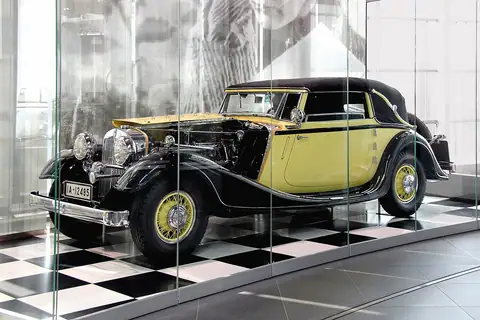
Horch
670 (V12)
Production not yet verified
71 other makes from Germany9ffAC SchnitzerAdlerAgria-WerkeAlbertAlpinaAMOAmphicarApolloArtegaAudiAuto UnionAutomobili PininfarinaBayerische AutowerkeBitterBMWBohseBoldmenBorgwardBovensiepenBrennaborBrütschChampionDauerDKWFMR (Messerschmitt)FuldamobilGemballaGepardGlasGoggomobilGoliathGumpertGutbrodHanomagHeinkelHorchHyundaiIFAIrmscherAll makes →