Makes › Lagonda › M45R Fox & Nicholl team cars · Factory competition · 1934–1935 Ultra Rare
Lagonda
M45R Fox & Nicholl team cars
Special 4½-litre team cars prepared by Fox & Nicholl for the 1934 TT
Still being researched: full specifications. Everything shown is checked against the cited sources. Know more? Send us a source.
Contents
01Overview
At a glance
- Built
- 3 Built
- Years
- 1934–1935
- Engine
- 4,467 cc / 4.5 LFactory: 4,467 cc
- Power
- 104 kW / 142 PSFactory: 140 hp · converted
- Top speed
- Not yet verified
- Body
- Not yet verified
- Designer
- Not yet verified
- In this archive
- Not yet verified
- Surviving
- 3 (independently researched)
Sources and any conflicting figures are in the sections below.
Why it matters
Fox & Nicholl built three special 4.5-litre Lagondas in 1934 with factory co-operation for the RAC Tourist Trophy, after a supercharger ban kept their Alfa Romeos out. One of them won the 1935 Le Mans 24 Hours outright.
How rare is it?
Six separate kinds of rarity – never combined into one number.
Each kind of rarity is rated separately and never combined.
02Production & history
Production
Every figure says what it counts.
| What is counted | Figure | Basis | Status |
|---|---|---|---|
| Total model productionall three BPK cars still existed and ran (Motor Sport 1972; again 1985) | 31 | Surviving examples | Independently researched |
| Total model productionteam cars built for 1934 ("The three cars were constructed in the summer of 1934") | 31,2 | Factory production | Registry reported |
Independent counts (e.g. engine and colour) are never combined into a calculated figure. Surviving examples are never presented as original production.
History
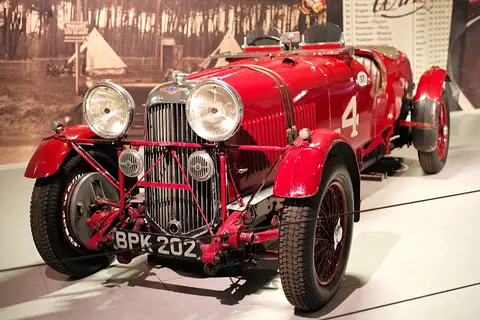
The three cars, registered BPK 201, 202 and 203, were built in summer 1934 and prepared at Arthur Fox's works on the Kingston by-pass. They were bright red with four-seater bodies, rounded tails with a central fin and a large petrol tank hidden in the tail. At the 1934 Tourist Trophy they finished fourth, fifth and eighth with Lewis, Hindmarsh and Cobb.
In 1935 BPK 202 won Le Mans and BPK 203 finished 13th after gearbox trouble; BPK 201 and BPK 202 later ran the 1935 Tourist Trophy. Motor Sport says the three cars made seven entries in two seasons and finished every time. They were sold in 1936 and all three still existed in 1972, with their original racing bodies.
Variants
How each version differs from the standard M45R Fox & Nicholl team cars.
No variants documented yet. Have a source? Contribute it.
03Specifications
Technical specifications
Engine
| Engine family | Not yet verified |
|---|---|
| Engine code | Not yet verified |
| Layout | Not yet verified |
| Displacement | 4,467 cc / 4.5 LFactory: 4,467 cc1 Independently researched |
| Bore | 85 mmFactory: 85 mm1 Independently researchedMotor Sport notes stroke figures vary between 120 and 120.65 mm and capacity between 4,429 and 4,467 cc across sources. |
| Stroke | 120 mmFactory: 120 mm1 Independently researched |
| Compression ratio | Not yet verified |
| Fuel system | Not yet verified |
| Power | 104 kW / 142 PSFactory: 140 hp · converted3 Independently researchedSource states bhp. |
| Power at | 3,600 rpm3 Independently researched |
| Torque | Not yet verified |
Transmission & drivetrain
| Gearbox | Not yet verified |
|---|---|
| Gears | Not yet verified |
| Driven wheels | Not yet verified |
Chassis, body & dimensions
| Chassis | Not yet verified |
|---|---|
| Front suspension | Not yet verified |
| Rear suspension | Not yet verified |
| Brakes | Girling drum brakes4 Independently researched |
| Steering | Not yet verified |
| Body construction | Not yet verified |
| Wheelbase | 3,124 mmFactory: 10.25 ft · converted1 Independently researched10 ft 3 in, measured by the author on BPK 203; BPK 201 owner reports the same. Earlier claim of 10 ft 9 in refuted in the article. |
| Length | Not yet verified |
| Width | Not yet verified |
| Height | Not yet verified |
| Front track | Not yet verified |
| Rear track | Not yet verified |
| Kerb weight | 1,500 kgFactory: 1,500 kg3 Independently researchedStated as "over 1500kg". |
| Dry weight | Not yet verified |
Performance
| Maximum speed | Not yet verified |
|---|---|
| 0–100 km/h | Not yet verified |
| Fuel tank | Not yet verified |
“Not yet verified” means no source has been checked for that value yet. Nothing is estimated to fill a gap.
04Colours & options
Factory colours & interiors
Original paint and trim, with the number of cars in each where a source gives it.
Not yet documented. Have a source? Contribute it.
Factory options & codes
Codes are shown exactly as written by the manufacturer.
Not yet documented. Have a source? Contribute it.
05Individual cars
Chassis register
Every documented car, with its colours, history and where it is now. Open a row for the full record. Known chassis are not automatically authenticated originals.
Not yet documented. Have a source? Contribute it.
Competition history
Every race result of the individual cars, in date order. Click a chassis number to open its full record in the register.
Not yet documented. Have a source? Contribute it.
Auction & sale history
Documented public sales of the individual cars. Click a chassis number to open its full record in the register.
Not yet documented. Have a source? Contribute it.
See one in person
Museums where an example of this car can be seen.
No example is documented on public display yet. Have a source? Contribute it.
06Reference
Identification guide
How to tell an original from a replica or later conversion.
Motor Sport (1972) records engine numbers M45/269, M45/270 and M45/271 for the three cars. The engines of BPK 201 and BPK 202 were swapped at some point, while BPK 203 retains its own. BPK 202 now has a different Lagonda gearbox from the original and BPK 203 an Alvis box. The two cars that ran in the 1935 Tourist Trophy, BPK 201 and 202, have louvred bonnet tops and BPK 203 retains its unlouvred 1934 top. Chalked "203" on the plywood panel base and "203" stamped under the bonnet boards helped identify BPK 203.
Sources
Each number links to the exact facts it supports.
-
1
The 1934 Fox and Nicholl Lagondas Level B Motor Sport Magazine · 1972-03
- a team of three special Lagondas
- all three still exist, in full working order
- specification sheet published by Henry Meadows Ltd. gives the bore at 85 mm and the stroke at 120 mm, with a capacity of 4,467 c.c.
- cylinder bore was 85 mm
- stroke at 120 mm
- Measuring BPK 203 ... I made it also 10 ft. 3 in.
-
2
Motor Sport, March 1972 – The 1934 Fox and Nicholl Lagondas Level C
- 3 team cars built for 1934 ("The three cars were constructed in the summer of 1934")
-
3
Lagonda's Le Mans upset (1935) Level B Motor Sport Magazine · 2023-05
- good for 140bhp at 3600rpm in tweaked form
- 140bhp at 3600rpm
- a car that weighed over 1500kg
-
4
1937 Lagonda LG45 Rapide (Lagonda profile) Level B Conceptcarz
- highly tuned engines, Girling drum brakes, and short chassis
Keep exploring
More from Lagonda
-
Lagonda · 1935
M45R Rapide (1935 Le Mans winner, BPK 202)
1 Built
-
Lagonda · 1938–1939
V12 Rapide
17 Built
-
Lagonda
Rapide (Aston Martin)
55 Built
-
Lagonda · 1938–1939
Lagonda LG6 (1937-1940)
63 Built
More from United Kingdom
-
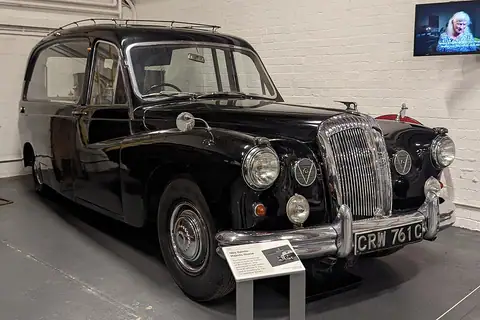
Daimler · 1958–1962
Majestic (1958-1962)
Production not yet verified
-
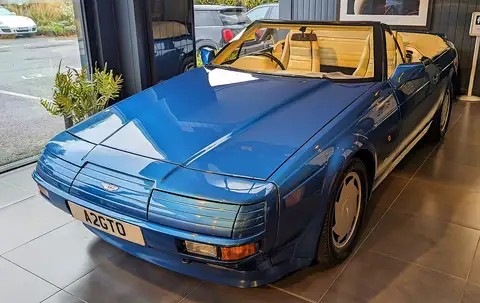
Aston Martin · 1987–1989
V8 Zagato Volante
37 Built
-
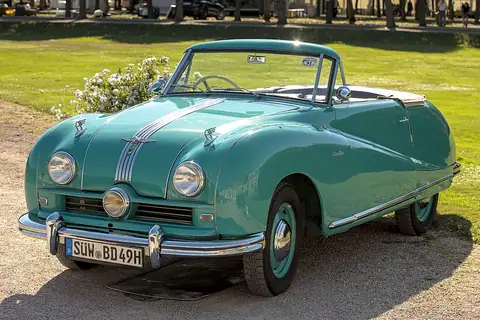
Austin · 1948–1952
A90 Atlantic
7,981 Built
-
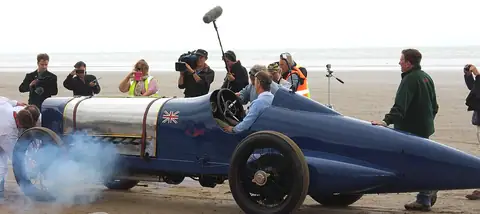
Sunbeam · 1920
350hp (Blue Bird)
1 Built
134 other makes from United KingdomACAiredaleAlan Mann RacingAllardAlvisArabArashArielArmstrong SiddeleyArrowsAscariAston MartinAtalantaAtlantisAustinAustin-HealeyBedfordBentleyBerkeleyBluebirdBMCBondBrabhamBristolBritish LeylandBroadspeedBrookeBrough SuperiorCampbell-RailtonCaparoCaterhamChevronConnaughtCooperCrayfordDaimlerDavid BrownDawsonDeLoreanDuttonAll makes →