Makes › Renault › 5 Turbo › 5 Turbo (Turbo 1) · Factory competition · 1980–1982 Rare
Renault
5 Turbo (Turbo 1)
Mid-engined Group 4/B homologation R5 with aluminium panels.
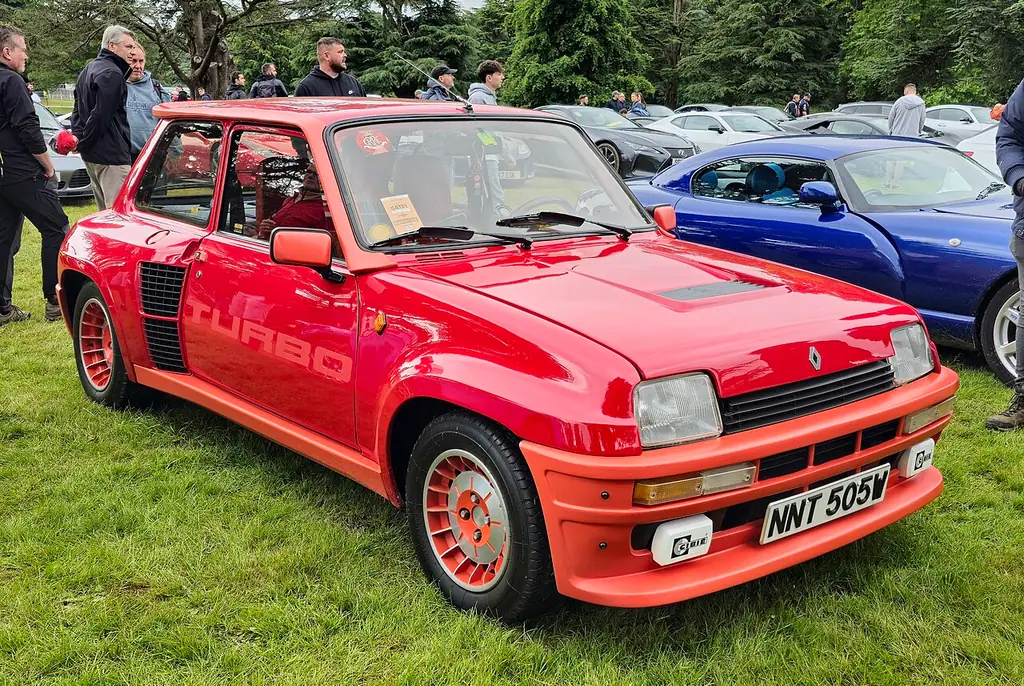
Photo: Calreyn88 · CC BY-SA 4.0
Contents
01Overview
At a glance
- Built
- 1,820 Built
- Years
- 1980–1982
- Engine
- Four-cylinder in-line, central longitudinal (mid-engine) · 1,397 cc / 1.4 LFactory: 1,397 cc
- Power
- 119 kW / 162 PSFactory: 160 hp · converted
- Top speed
- 200 km/hFactory: 200 km/h
- Body
- Not yet verified
- Designer
- Bertone (Marcello Gandini)
- In this archive
- Not yet verified
- Surviving
- Not yet verified
Sources and any conflicting figures are in the sections below.
Why it matters
The Turbo 1 is the first Renault 5 Turbo: a mid-engined, rear-drive rally homologation special built on the Renault 5 body, with the engine where the rear seats had been. The first 400 cars were built to meet Group 4 rules and went on to win the Monte Carlo Rally with Jean Ragnotti.
How rare is it?
Six separate kinds of rarity – never combined into one number.
Each kind of rarity is rated separately and never combined.
Photos
Exterior, interior and detail photos with their licences.
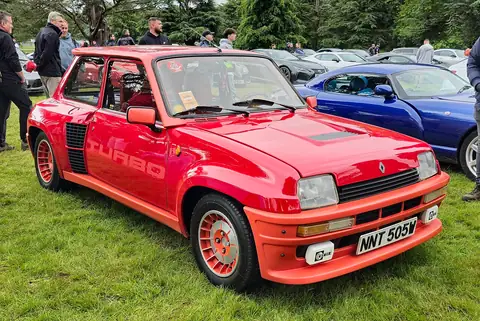 Renault 5 Turbo (Turbo 1) (Wikimedia Commons: Renault 5 Turbo)
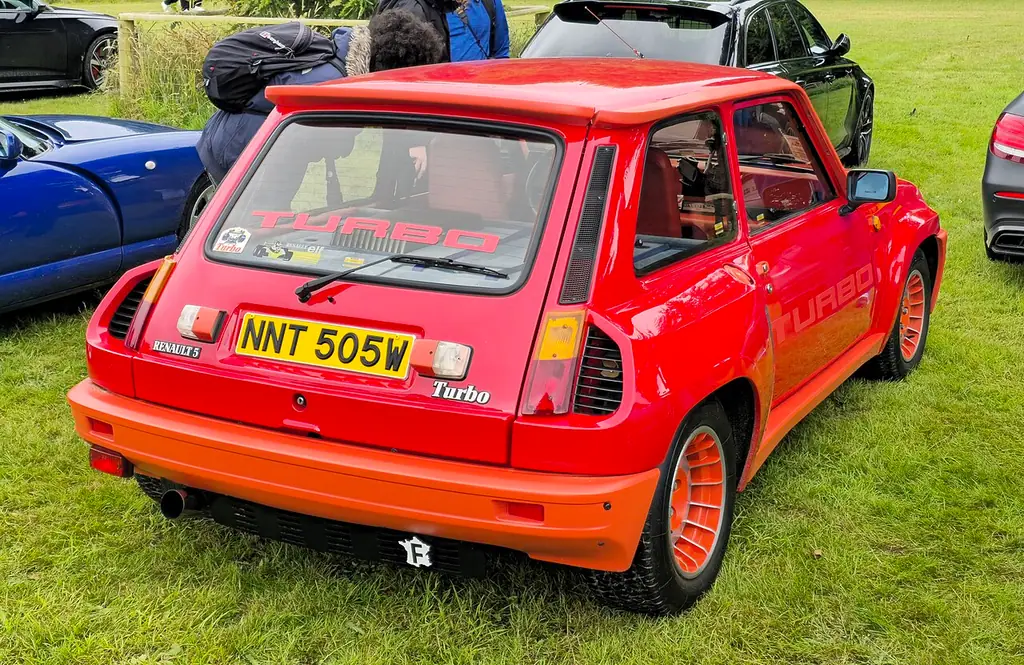
Photo: Calreyn88 · CC BY-SA 4.0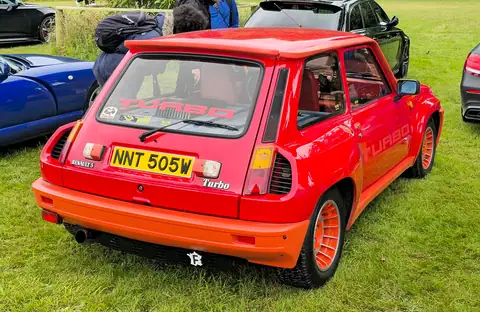 Renault 5 Turbo (Turbo 1) (Wikimedia Commons: Renault 5 Turbo)
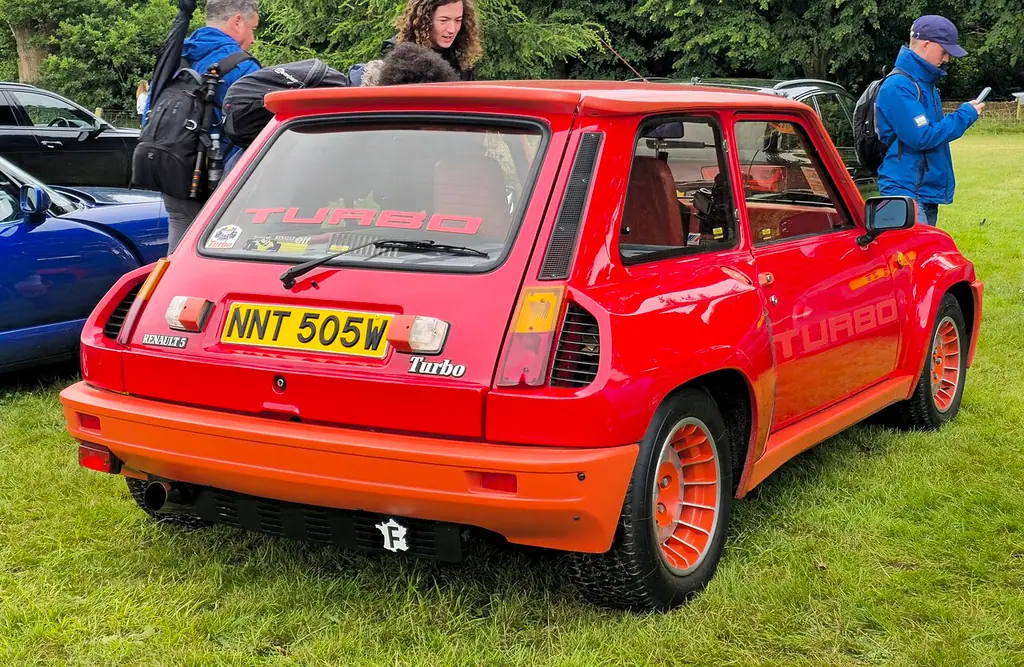
Photo: Calreyn88 · CC BY-SA 4.0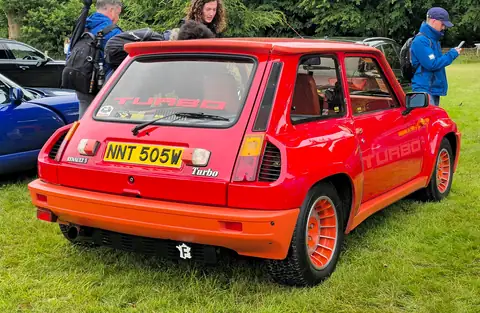 Renault 5 Turbo (Turbo 1) (Wikimedia Commons: Renault 5 Turbo)
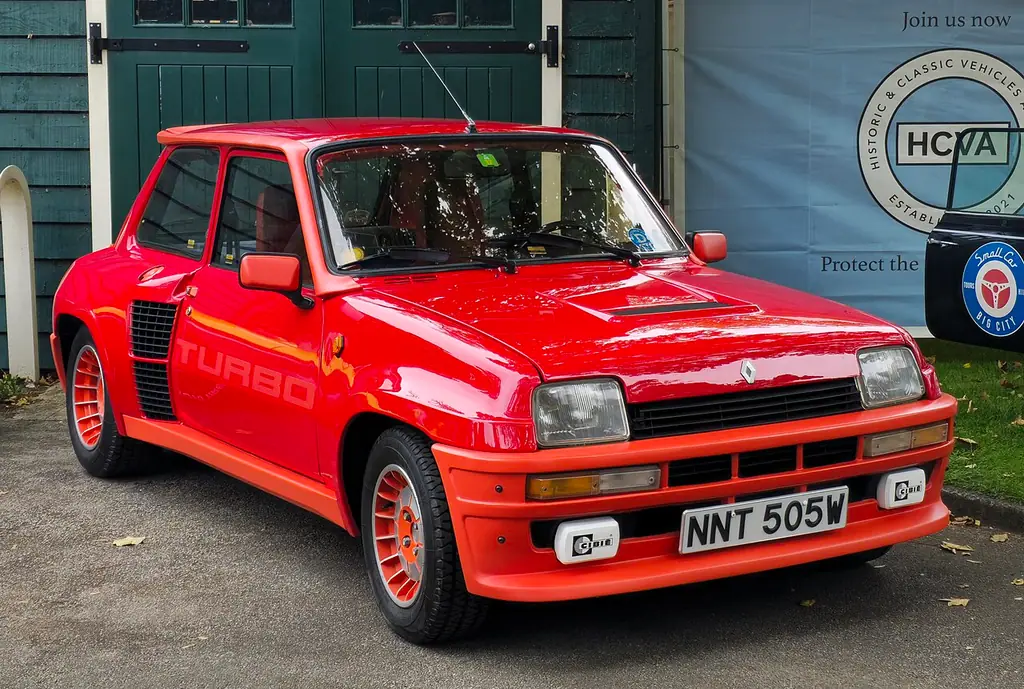
Photo: Calreyn88 · CC BY-SA 4.0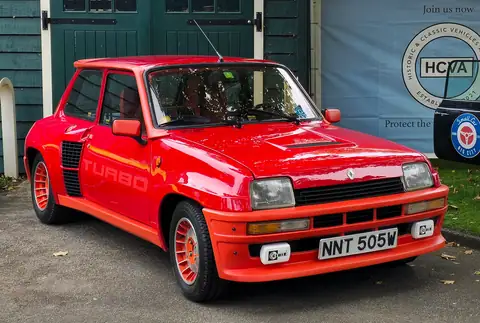 Renault 5 Turbo (Turbo 1) (Wikimedia Commons: Renault 5 Turbo)
Photo: Calreyn88 · CC BY-SA 4.0


02Production & history
Production
Every figure says what it counts.
| What is counted | Figure | Basis | Status |
|---|---|---|---|
| Total model productionTurbo 1 built (of 4,987 R5 Turbo) | 1,8201 | Factory production | Independently researched |
Independent counts (e.g. engine and colour) are never combined into a calculated figure. Surviving examples are never presented as original production.
History
The Renault 5 Turbo was shown as a static mock-up at the October 1978 Paris Motor Show. Bodies were built at Flins, converted by Heuliez at Cerizay (5 cm longer, aluminium roof and door panels, front strut brace) and assembled by Alpine at Dieppe, with the Garrett-turbocharged engine, five-speed gearbox, interior and paint. The first 400 cars were needed for FIA homologation.
Renault says 802 were built in 1980 as model year 1981, 536 in 1981 and 352 in 1982, with changes in 1982 including a more efficient intercooler, steel doors instead of aluminium, and new colours. The name "Turbo 1" distinguishes it from the Turbo 2.
Variants
How each version differs from the standard 5 Turbo (Turbo 1).
No variants documented yet. Have a source? Contribute it.
03Specifications
Technical specifications
Engine
| Engine family | Not yet verified |
|---|---|
| Engine code | Not yet verified |
| Layout | Four-cylinder in-line, central longitudinal (mid-engine)2 |
| Cylinders | 43 Independently researched |
| Displacement | 1,397 cc / 1.4 LFactory: 1,397 cc2 |
| Bore | 76 mmFactory: 76 mm2 |
| Stroke | 77 mmFactory: 77 mm2 |
| Compression ratio | 7:12 |
| Valvetrain | Side-mounted camshaft2 |
| Fuel system | Bosch K-Jetronic fuel injection2 |
| Induction | Garrett T3 turbocharger2 |
| Power | 119 kW / 162 PSFactory: 160 hp · converted2Rating: manufacturer |
| Power at | 6,000 rpm2 |
| Torque | 210 Nm / 21.4 kgmFactory: 21.4 kgm2 |
| Torque at | 3,250 rpm2 |
Transmission & drivetrain
| Gearbox | 5-speed manual, dual-disc clutch2 |
|---|---|
| Gears | 52 |
| Driven wheels | Rear-wheel drive2 |
Chassis, body & dimensions
| Chassis | Strengthened Renault 5 monocoque with a tubular structure carrying the engine and transmission4 Independently researched |
|---|---|
| Front suspension | Double wishbones, torsion bars, anti-roll bars, telescopic dampers2 |
| Rear suspension | Double wishbones, torsion bars, anti-roll bars, telescopic dampers2 |
| Brakes | Ventilated discs front and rear2 |
| Steering | Rack and pinion2 |
| Body construction | Steel monocoque, 2 seats2 |
| Wheelbase | 2,430 mmFactory: 2,430 mm5 Independently researchedFrom the Turbo 2 data sheet; the Turbo 1 is not given separately. |
| Length | 3,660 mmFactory: 3,660 mm5 Independently researched |
| Width | Not yet verified |
| Height | Not yet verified |
| Front track | Not yet verified |
| Rear track | Not yet verified |
| Kerb weight | 970 kgFactory: 970 kg2 |
| Dry weight | Not yet verified |
Performance
| Maximum speed | 200 km/hFactory: 200 km/h2Planète Renault quotes 210 km/h. |
|---|---|
| 0–100 km/h | Not yet verified |
| Fuel tank | Not yet verified |
“Not yet verified” means no source has been checked for that value yet. Nothing is estimated to fill a gap.
04Colours & options
Factory colours & interiors
Original paint and trim, with the number of cars in each where a source gives it.
Not yet documented. Have a source? Contribute it.
Factory options & codes
Codes are shown exactly as written by the manufacturer.
Not yet documented. Have a source? Contribute it.
05Individual cars
Chassis register
Every documented car, with its colours, history and where it is now. Open a row for the full record. Known chassis are not automatically authenticated originals.
Not yet documented. Have a source? Contribute it.
Competition history
Every race result of the individual cars, in date order. Click a chassis number to open its full record in the register.
Not yet documented. Have a source? Contribute it.
Auction & sale history
Documented public sales of the individual cars. Click a chassis number to open its full record in the register.
Not yet documented. Have a source? Contribute it.
See one in person
Museums where an example of this car can be seen.
No example is documented on public display yet. Have a source? Contribute it.
06Reference
Identification guide
How to tell an original from a replica or later conversion.
The Turbo 1 has aluminium roof and door panels and a strengthened bodyshell, wide box arches by Bertone (Marcello Gandini), and a red and blue interior with an asymmetrical steering wheel. The 1397 cc turbo engine sits longitudinally behind the seats, and the rear suspension comes from the Alpine A310. Tyres are 190-section at the front and 220-section at the rear. It weighs about 900 kg, against 970 kg for the later Turbo 2, and was built between June 1980 and September 1982.
Sources
Each number links to the exact facts it supports.
-
1
Sports Car Market – 1983 Renault 5 Turbo profile Level B
- 1820 Turbo 1 built (of 4,987 R5 Turbo)
-
2
Renault 5 Turbo - Les Cahiers Histoire et Passion Level A Renault Classic (Renault Group)
- Engine: 4 in-line cylinders; Positioning: central longitudinal
- Capacity: 1,397 cm3
- bore x stroke: 76 x 77 mm
- Compression ratio: 7 :1
- Timing gear: side-mounted camshaft
- Bosch K Jetronic electronic fuel injection
- Supercharging: Garrett T3 turbocharger
- Max. power: 160 hp at 6,000 rpm
- 160 hp at 6,000 rpm
- Max. torque: 21.4 mkg at 3,250 rpm
- 21.4 mkg at 3,250 rpm
- Gearbox: 5-speed gearbox; Clutch: dual disc
- 5-speed gearbox
- Transmission: rear wheel drive
- Suspension: double wishbone front and rear suspension, torsion bars, sway bars
- double wishbone front and rear suspension
- brakes: front and rear ventilated discs
- Steering: rack and pinion
- bodywork type: steel monocoque, 2 seats
- Weight: 970 kg
- Top speed: 200 km/h
-
3
Renault 5 Turbo: review, history and specs of an icon Level C evo
- In-line 4-cyl, 1397cc, turbo
-
4
Renault 5 Turbo: Birth of an icon: 1980 Level C Ian Eveleigh · evo
- a hole was cut in the rear floor of the 5's monocoque and a tubula[r structure]
-
5
Renault 5 Turbo 2 data sheet (text on first 400 cars) Level C Classic & Performance Car (web archive copy)
- Wheelbase: 2430mm
- Length: 3660mm
Keep exploring
More from Renault
-
Renault
Espace F1
1 Built
-
Renault · 1956
Étoile Filante
2 Built
-
Renault · 1985
5 Maxi Turbo
20 Built
-
Renault · 1898
Type A Voiturette
71 Built
More from France
-
Bollore
Bluecar
Production not yet verified
-
Peugeot
Type 184
Production not yet verified
-
Alpine
A110 GT Jean Redele
Production not yet verified
-
Salmson · 1953–1957
2300 S
227 Built
70 other makes from FranceACMAAixamAlcatelAlpineAmilcarArzensAvions VoisinBACBallotBerlietBolloreBuccialiBugattiCGCharron, Girardot et VoigtChenard-WalckerCitroënClément-PanhardDAMSDarracqDBDB (Deutsch-Bonnet)De DietrichDe Dion-BoutonDe Dion, Bouton et TrépardouxDe La ChapelleDelageDelahayeDelaunay-BellevilleDerbyDSExagonFacel VegaFarmanFord FranceGentyGordiniHommellHopiumHotchkissAll makes →